Sunday, January 15, 2023

The morning train to Cambodia

January 15, 2023

An early train heads east from Bangkok to the Cambodian border, covering the 255 kms in a little more than 5 hours, at a cost of 49 Thai Baht (only US $1.50). Never too crowded, the number of passengers varied, but generally decreased as we left the outskirts of Bangkok. The windows opened wide to let in the warm breeze and there was an oscillating, rotating fan on the ceiling (1).

Hawkers come on the train selling food and drinks, calling out their wares in sing-song voices (in Thai, but I can point). The steady procession of them getting on and off at various stations ensured warm food and cold drinks (2). The fried egg with rice and carrot bits was tasty and set me back 20 Thai Baht (about 60 US cents).

The train ran through the southeastern Thai plains, with rice fields obscured by the morning fog, which lifted as the sun rose. Further east, the rice fields yielded to groves of tall, spindly trees planted in neat rows. Many flocks of birds were flushed by the noisy train, taking to the sky.

The train arrived at the border station on time. Clearing outbound Thai immigration (very grouchy officer) and inbound Cambodian immigration (officer, indifferent) took about 45 minutes. Nothing in the border town of Poipet invites lingering, so I moved on, opting for an air-conditioned taxi (3), rather than a crowded bus to Siem Reap. 

At the hotel in Siem Reap, A local family, friends of the hotel owner came by banging a drum and jumped on the pool. Playing an informal pool basketball game, I was the ball retriever when it bounced out of the pool. As dusk, the mosquitos appeared (4), followed by the hotel proprietor with a mosquito coil, then the muezzin's sonorous call to prayer from a nearby minaret.

A later walk revealed the city to be noisy and loud, with a very honky-tonk feel. The girls working in the massage parlors were particularly aggressive, standing beside each other to try to block my passage down the sidewalk.

(1) A man sitting opposite asked (in mime) if the fan bothered me and showed me how to shut it off if I wished. I didn't.

(2) This is common practice in South Asia. On a Vietnamese train a few years ago, the vendors would said "hot" or "cold" and put the food or drink against my arm as proof.

(3) Bit of a disaster. Nearing Siem Reap, a Police officer pointed at the taxi driver to pull over for talking on his phone while driving (a). Instead, the driver dashed down a rutted dirt road to avoid the fine; the police, not wanting to endanger the undercarriage or suspension  did not follow. I was glad to get out at the hotel.

(a) While I rarely take taxis, I had a similar experience in Bucharest a few years ago. The taxi driver was clearly manipulating the meter and I called him on it. Coincidentally, a cop soon pulled him over for mobile phone use while driving. I simply got out of the cab and walked to the opera in the rain.

(4) Malaria is considered eradicated in Siem Reap, but not in the surrounding countryside. 
Hua Lamphong station (in daylight the afternoon before)
Pictures of the Royals at Hau Lamphong train station 
Easy to find the right train
The cowherd gave a nice smile and wave
Tidy railway stationGrove of spindly trees
The Royal Standard (in yellow) and the Thai national flags fluttering in the light west wind
Temple north of the tracks
Three clangs of the bell is the equivalent of "All aboard"

Saturday, January 14, 2023

Poking about Bangkok

January 14, 2023

After an overnight layover in Manila (never again), I arrived in Bangkok (1) mid-morning and hopped the train downtown. Walking to the hotel, a man started chatting with me: "You're not Thai, you're too tall" (2). He seemed genuinely proud to tell me of the wonderful things to see and do in Bangkok.

I wandered from the hotel (near Hua Lamphong station) through the warren of streets that appeared to be the metal-working part of town. There was a dock with a ferry approaching; I hopped on. The ticket seller jangled a metal canister of coins, while the deckhand in back blew his whistle (3). The boat headed north, affording fine views of the old city to the west and the new city to the east. 

At one bridge, I noticed the metro high above. An elevated metro is another good way to see the city; off the boat and onto the metro going down the west side of the river (4), seeing the other side of many of the buildings and temples on the river.

A local bike company offers a night tour of the city. I joined two Americans on vacation from the US consulate in Almaty, Kazakhstan (5). We rode on streets, on sidewalks, down alleyways too narrow for bikes, and through a market. We were either in danger or endangering others. After passing through the woodworking and basket weaving part of town, we crossed the river by ferry. The tour finally stopped at the Wat Arun (Dawn Temple) to hear some of the city's history.  before stopping (at a 7-11) to get drinks and sample some street food (6) at the night flower market. The trip ended by circling the Royal Palace on car-free streets.

(1) "Bangkok" means place for olive trees, although the city's official name has too many syllabus to count: "Krung Thep Mahanakhon Amon Rattanakosin Mahinthara Ayuthaya Mahadilok Phop Noppharat Ratchathani Burirom Udomratchaniwet Mahasathan Amon Piman Awatan Sathit Sakkathattiya Witsanukam Prasit."

(2) My B.S. radar detected no danger. As an older man travelling alone, I am ocassionally approached by people trying to scam me, or to "find me a girl."

(3) The deckhand's whistle pattern sermed to be:
1. approaching a stop: 
a. one short whistle: no need to stop, nobody getting off
b. multiple short whistles: stop requested
2. at a stop:
one long whistle: the boat is cast off & ready to go.

(4) For a metro without a flat fare, Bangkok's is very visitor friendly. Hit the station you want to go to on the screen and it tells you the fare; deposit the fare and you're good to go. Or, you can just tap your credit card at the entrance and exit gates with no thought needed (a).

(a) Unlike the train from the International arrivals hall, which does not take credit cards, only local currency (but not the dominations dispensed at the adjacent ATMs). They obviously did not think this through.

(5) The guide was pleased I came; I was the first walk-in they've had in 3 years (most of which they were closed due to Covid).

(6) I had already pointed at random meat on a stick on Bangkok's sidewalks a few times today. It which worked out well (usually for me, occasionally for the stray dogs which are common in the city).

In the metal working district
The river ferry, reminiscent in form and function to a Venetian vaporetto.
View of Wat Arun from the river
Cable stay bridge from 2012 over the Chao Praya linking the old and new parts of the city.
View of temple complex from the metro
View from hotel rooftop terrace
Wat Arun at night
Detail of Wat Arun, made of porcelain
In the Wat Arun complex
View of the Royal Palace across the river
Igreza Santa Cruz, built by the Portuguese Catholic Community in Bangkok. Judging by the small bells ringing, the Mass (in Thai) was at the moment of the consecration of the hosts.
The night flower market
The Royal Palace complex


Friday, January 13, 2023

Snorkeling the coral reefs of Palau

January 13, 2023

Arrived in Palau, a small nation comprised of some 200 islands, just after midnight. Palau reopened a few months ago, having been closed to visitors for more than 2 years due to Covid. The passport entry stamp is a pledge written by the children of Palau:

Children of Palau,
I take this pledge,
as your guest,
to preserve and protect
your beautiful and unique 
island home.

I how to tread lightly,
act kindly and
explore mindfully.

I shall not take 
what is not given.

I shall not harm 
what does not harm me.

The only footprints 
I shall leave are those
that will wash away.

The immigration officer stamp the pledge in my passport and made me sign it before admitting me (1).

Wandered to a dive & tour shop this morning. "No tours today. Our boats are in the shop for maintenance." Enquiry at the hotel front desk yielded a snorkeling tour with space available (2). There were three Taiwanese and another American (3). Before departing, we had to buy a pass to enter the national park; while nobody checked the passes, everyone took the process seriously. 

The first stop was the "milky way," with crushed limestone sand on the sea bottom that people rub all over themselves to take pictures to post on social media. I noted the care with which the guides washed off the docks before leaving. 

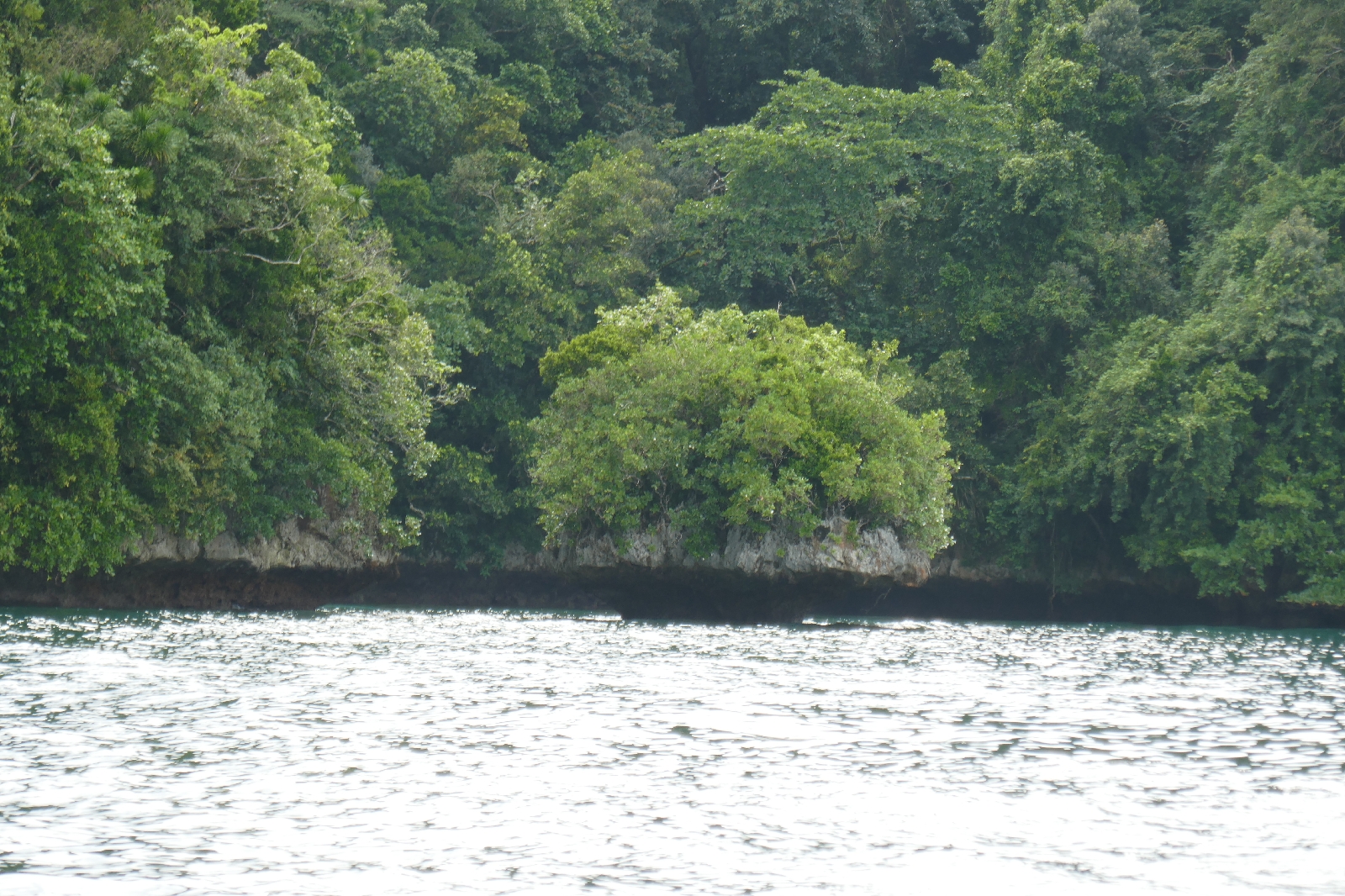
The tour stopped at three snorkeling sites above coral reefs. The two other boats doing similar tours all cooperated to ensure no overcrowding. The vibrant colors of the fishes and corals were beautiful. 

I was admiring a luminescent blue piece of coral when it moved; a crab apparently that slips into the crevices of the coral. At one stop, Grant (our guide) said "Nemo's here." I thought I misheard him, but he was referring to the clown fish, which is the species depicted in the movie Finding Nemo. Swimming at a beach, a group of sharks swam over.

On the ride back, we stopped at a natural arch, where the limestone had worn sway. At a natural cave, the Japanese had stored fuel during WW2; the charred remnants are still there. 

Overall, there is a very nice ethos here in Palau. People seem to appreciate where they are, and respect the environment. The relative small number of visitors probably helps; there is one daily flight to Guam, two flights per week to Manila, and one flight per week to Taipei.

(1) I hopped in the hotel shuttle and noticed the right side steering wheel. Although they drive in the same side as in the States (being a former American protectorate), most of the cars have a steering wheel on the wrong side. Most cars here are used vehicles imported from Japan, where the population likes newer cars, creating a glut of late model used vehicles with right side steering wheels.

(2) A popular tour in Palau goes to swim at Jellyfish Lake. Long ago, the lake was separated from the sea by volcanoc activity. The jellyfish trapped in the lake faced no predators, and they evolved to be stingless. Due to overuse (especially of sunscreen) by visitors, the jellyfish population was threatened, and the lake was closed to visitors for a few years to permit the population to regrow. This tour was not available, which was OK for me; let them rest.

(3) As it happens, he also booked the snorkel tour this morning. He was on my flight from Guam last night and we are on the same flight to Manila tonight. He was flying standby yesterday to Manila and they offered him either a night in Guam or a night in Palau.

Sharks at the beach
Notice the erosion of the limestone at water level
Where the Japanese stored fuel for seaplanes
Japanese cannon
Palau, with its 18,000 residents is divided into 16 states, the smallest of which (Hatohobei) has population of 25.
Japanese anti-aircraft gunNight flight to Manila. Sitting at the gate, I noticed the runway lights come on, signalling that the plane was within range (4)

(4) No need to leave the lights on all night for one plane.

Thursday, January 12, 2023

The Island Hopper across the Pacific

January 11/12 2023

Air Micronesia began flying in 1968 from Honolulu to Guam with stops on various islands in between. Air Micronesia was bought by Continental, which subsequently merged with United, which still operates the Island Hopper service three days a week. As checked baggage, many of the passengers returning to their home islands had coolers full of groceries they had bought in Honolulu. One guy opened his and it appeared to be full of bags of snack-sized Snickers bars.

The longest leg is 5 hours from Honolulu to Majuro in the Marshall Islands. Having  crossed the international date line, it's now January 12. As we descended, I noticed an oval-shaped flat atoll out the window enclosing a large bay, this was Majuro. We passed north of the island before turning left and descending for a landing at the airport, squeezed onto the south side of the narrow island. Continuing passengers can disembark here for a brief respite. While waiting in the transit area, a windy rain storm blew through.

The Marshall Islands were administered by the US (1) under a UN trustee mandate until the islands' independence in 1991. The islands are in free association with the US, permitting island citizens to live and work in the US. and obligating the US to defend the islands.

The cockpit crew which flew the aircraft from Honolulu swaps places with the crew who has been deadheading to this point (2). A mechanic and other airline personnel ride on the flight to assist at the stops. As we departed, the whole Majuro ground crew assembled to wave goodbye (2).

The Wednesday Island Hopper service skips the next two stops (at Kwajalein (a US military base) and Korsae), flying directly to Pohnpei in the Federated States of Micronesia (4). As with Majuro, the plane flies over the island to the north before turning to land into the easterly trade wind. Pohnpei is a much hillier island the Majuro and is ringed by a barrier reef clearly visible from the air.

Due to continuing Covid restrictions (5), through passengers stayed on the plane, which was relatively empty at this point. There was a convivial atmosphere with a large number of airline employees on the plane who chatted amiably with each other and with the passengers (6).

The final stop is at Chuuk in Micronesia. The Island, formerly known as Truck, was the site of a major battle in the 1944 during the second World War. 

The flight ended back in the US at Guam. Outside the terminal, I was greeted by two of the air crew who were driving home as I set off to walk the 2 miles to town. I had forgotten I was back on the U.S. The narrow dis-used sidewalk was slick with some sort of slime (from the damp climate) and abruptly ended at the edge of airport property, leaving me stranded on the side of a busy road. Back to the airport for my late flight to Palau.

(1) The FAA limits the work day of pilots, generally to 8 hours of flying time. 

(2) Bikini Atoll, site of the first Hydrogen bomb test (and still uninhabitable due to the testing), is part of the country's territory.

(3) A ground crew member approached the plane holding a long stick with a clip at the end containing a piece of paper, which he held up for the pilot to take from the cockpit window. The pilot told us that telecommunications were down on the island, so they needed to go old-school with the paperwork.

(4) Micronesia is also in free association with the US, having gained their independence in 1990.

(5) One of the flght attendants told me he had seen the hospital in Chuuk (the next stop) and they could not handle the infection.

(6) One airline employee heading home to Guam sat next to me on the final leg and shared some of his home-made tuna jerkey

The Majuro Atoll
Majuro airport
Rain squall at Majuro
Majuro ground crew waving goodbye while twirling their umbrellas in the rain
Descending to Pohnpei
View of reef departing Pohnpei
At Chuuk
In the last leg: to Guam
Route highlighted on in-flight magazine

Wednesday, January 11, 2023

Kayaking Kāneʻohe Bay

January 10, 2023

The bus from Honolulu to Kualoa takes about 1 1/2 hours and costs only $3.00 (1). My body was still on East Coast time (Hawaii time + 5 hours), so I awoke about 5:00 and took an early bus. The sun was rising as I arrived at Kualoa State Park (2). Dave, the kayak tour guide came as planned at 8:30.

We soon paddled into the bay, spotting a monk seal coming up for air. Paddling out, we noticed the splash from a whale's flipper and headed further offshore on this calm morning. Lingering near the harbor entrance buoy, a humpback whale emerged from the deep, just 10 or 15 yards away. I backed away as the enormous whale lingered on the surface, spouting from its blowhole. Under her dorsal fin, she was sheltering her newborn calf (3), who poked his or her head up a few times to look around. This was Dave's first whale siting this year, and one of his closest ever (4). A sea turtle appeared on the paddle back, gliding smoothly under the water.

Mokoliʻi Island (5) means "dragon's tail" in Hawaiian, because the adjacent ridge on the mainland looks somewhat like a dragon (if you have vivid imagination). We ascended the (slightly) less steep south face of the hill (6), maintaining four points of contact most of way on the rocky scramble up: two feet and two hands. The sweeping views from the 206 foot summit encompassed the whole bay. The descent was a even more intimidating, with five points of contact (the aforementioned four, plus my butt; safety trumps pride). On the descent, I noticed some unusual bushes with flowers in purple, yellow and orange all on the same cluster (7)

A short paddle brought us back to Kualoa State Park, where Dave's wife, Kat was waiting with lunch. Kat offered me a ride in the bed of her pickup truck to Turtle Bay (8), at the northwest corner of the Island. My last ride on the bed of a pickup was when I was about twelve, so I hopped in. I enjoyed an iced coffee and the view at Turtle Bay Resort, before grabbing the bus for the two hour (and still $3.00) bus ride back to Honolulu (8).

(1) When the bill insertion machine works, which it seems to about half the time (a).

(a) The ride from the airport last night explains why so few tourists use the bus. Unless you have a Holo card (which you can't buy at the airport), you need exact change to board the bus at the derelict-looking, unlighted bus stop at the airport, which had no schedule information posted.

(2) The typical quick sunrise in the tropics, not the long lingering sunrises (and sunsets) we get in the higher attitudes back home, especially in the months surrounding the solstices.

(3) The whales migrate to Hawaii in the winter to give birth. During their residence at the islands, they do not eat, as their normal diet of plankton grows better in the colder waters further north. Dave marvelled that the moms nurse the babies with about 100 lbs of milk each day, drawing upon her own body mass to do so.

(4) He frequently exclaimed: "This is awesome, Dude." 

(5) Also known as "China Man's Hat," for its shape.

(6) There are caves on the northern cliff-face, into which deceased Hawaiians have been descended from the summit, judging by the bones that have been found there.

(7) I was too focused on not slipping and dying on the descent to take a picture.

(8) Kat's truck is a manual, which Dave has never figured out how to drive. When Kat was first learning, her father said to her "Only rich people can afford an automatic transmission. We're not rich, so you need to learn on a manual."

(9) The waves were 10 to 15 feet on the north side today (the waves were predicted to be 50 feet tomorrow), so an impromptu surf competition was happening, slowing traffic further up the road. I therefore returned the way I had come. 
Sunrise over Kāneʻohe Bay
View of Mokoliʻi
Kualoa Ridge
Mama Humpback 
Views from summit of Mokoliʻi
Marker at the 206 foot summit
View from the back of the pickup
At Turtle Bay